space engineers how to tell what is using power
Electricity is a arrangement and resource in Space Engineers that is used to power well-nigh devices. It is created using a Large Reactor, Minor Reactor, Current of air Turbine, Hydrogen Engine, or Solar Panel. It can be stored in a Bombardment and discharged to the filigree it is built on. Any device that has a direct block connection to a power source will be powered by that power source; that is, if a reactor is on a ship, all devices attached to that ship should receive power - provided there is enough power to supply all active blocks on the grid.
Electricity can pass through rotor blocks, pistons, hinges and locked connectors (incl. small-to-large connections), but not landing gears. Most blocks have off switches if you lot want to save electricity temporarily, which is particularly useful in Survival Mode.
Contents
- 1 Electricity fundamentals & Terminology
- i.i Power System Priorities
- 2 Energy sources
- 2.1 Large Reactor vs Small Reactor
- 3 Power Usage
- 3.1 Thruster
- 3.2 Product (Private Usage)
- 3.three Weaponry and tools
- 3.4 Communication
- 3.five Other device ability usages
Electricity fundamentals & Terminology
In Infinite Engineers the rate of free energy transfer and energy conversion is expressed in watt (Due west). The unit watt comes normally prefixed to kW or MW, as seen in the tabular array. An corporeality of stored electricity is expressed in watt hours (Wh), which can be thought of as the product of a rate of energy transfer and a time this rate was sustained. If, for instance, y'all demand 500 W for 5 hours, a battery storing electricity to the amount of 500W*5h = 2500 Wh = 2.5 kWh will suffice. Typically you will encounter Wh, kWh, and MWh units in the game referring to stored energy in a charged battery or in fuel like uranium ingots. Conversely, W, kW, and MW units describe a rate consumers (e.g. refineries) and producers (due east.1000. reactors) of electricity work at.
| Conversion Tabular array | Watt (W) | Kilo-Watt (kW) | Mega-Watt (MW) |
|---|---|---|---|
| Mega-Watt (MW) | 1 000 000 W | one 000 kW | 1 MW |
| Kilo-Watt (kW) | 1 000 Westward | 1 kW | 0.001 MW |
| Watt (W) | ane W | 0.001 kW | 0.000 001 MW |
Reactors are the principal source of reliable electricity, and they crave Uranium ingots equally fuel. 1 kg of uranium ingots will exist exploited for i MWh of power. That is the equivalent of a reactor being drawn on to supply one MW for 1 hour, or 2 MW for half an hour and and so on.
A large block Small Reactor generating electricity at its maximum rate of 15 MW to supply a large ship'due south total electric needs (such every bit refineries, thrusters at total capacity, etc), will consume 1 kg of uranium in 4 minutes, while a large block Large Reactor will consume one kg of uranium ingots in equally piddling as 12 seconds at its full output of 300 MW. Consumption of Uranium is solely decided by your current energy demand. In that location is no departure in efficiency betwixt large and modest reactors per uranium ingot, then a large reactor doesn't utilise uranium or extract any more energy out of uranium ingots than any small 1 would. Information technology besides makes no difference how many reactors yous have online, reactors that are not needed will not draw any unnecessary power or use whatsoever uranium within them until required.
A Battery is special in that it doesn't generate electricity, it only stores it for later use. Information technology'due south wise to combine renewable electric generation from solar panels with batteries and not reactors since a battery charging from the latter is merely lxxx% efficient. This efficiency penalisation means that a battery needs 20% more ability (Wh) for the energy it will shop and return. That is while information technology will return 3 MWh (for large batteries) charging at a maximum rate of 12 MW, the battery will require 3.6 MWh for a full charge, thus 600 kWh volition be wasted. A Large Send bombardment continuously drawn on at its maximum output rate of 12 MW, beginning at total accuse of 3 MWh, volition deplete in 15 minutes.
Power System Priorities
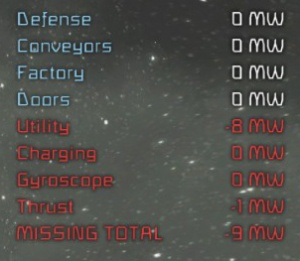
In the event of power failure or a power deficit, the grid will likewise prioritize what receives ability.
In Space Engineers, electricity sources are ranked in club of which of them will be used first to fulfill electrical demand as a sort of automated intelligent power management sub-arrangement. The purpose of this is to utilise power sources intelligently, for example if there is both a Solar Panel and a Large Reactor bachelor to utilize. Instead of equally distributing a load across them the grid will attempt to utilise all of the output of a solar panel, before using the reactor and use the reactor to make upwards any deviation in demand that the solar panel cannot provide. Thereby saving Uranium, instead of needlessly letting solar ability become to waste.
In addition to this, the electrical organisation will also prioritize certain sub-systems over others in the event of a ability deficit - that is, insufficient output bachelor to run across demand. Virtually of the lower ranked ones such as Batteries, Thrust and Charging are adaptable significant they automatically handle reduced input but part with lesser effect for thrusters this means they still provide thrust but non equally much as they could at full power, while batteries simply take longer to recharge. Certain systems are not adaptable meaning they either receive ability or don't resulting in blocks shutting off.
Power Sources in order of Priority:
- Solar Panel / Wind Turbine
- Hydrogen Engine
- Big Reactor / Small Reactor
- Battery / Pocket-sized Bombardment
Power Consumers in guild of Priority
- Defence force - Interior Turret, Missile Turret, etc
- Conveyors - Conveyor, Conveyor Tube, blocks that make up the Conveyor Network, etc
- Factory - Refinery, Assembler, Oxygen Generator, Air Vent, Oxygen Tank, etc
- Doors - Door, Airtight Hangar Door, etc
- Utility - Communications, Lights, Rotor, Piston, Medical Room, Gravity Generator, the vast majority of electronics, etc
- Charging - Jump bulldoze, specifically players within cockpits or passenger chairs, recharging their suits.
- Gyro - All Gyroscopes
- Thrust - Standard Thrusters, but not hydrogen based thrusters
- Batteries - Any Batteries attempting to charge themselves.
Free energy sources
Maximum output for Electricity Sources:
| Block size | Energy Source | Dimensions | Volume | Mass | Max Output | Mass Efficiency | Energy Density |
|---|---|---|---|---|---|---|---|
 Big Big |  Large Reactor Large Reactor | 3,three,3 | 421.875 yard3 | 73,795 kg | 300 MW | 4,065 kW/kg | 711 kW/miii |
| Big |  Pocket-sized Reactor Pocket-sized Reactor | ane,1,i | xv.625 one thousand3 | iv,793 kg | 15 MW | 3,130 kW/kg | 960 kW/m3 |
| Large |  Hydrogen Engine Hydrogen Engine | 1,i,two | 31.25 m3 | 3,253.eight kg | 5 MW | i,537 kW/kg | 160 kW/m3 |
| Large |  Solar Panel Solar Panel | 4,2,ane | 125 m3 | 516.8 kg | 0.xvi MW | 310 kW/kg | 1 kW/k3 |
| Large |  Wind Turbine Wind Turbine | 3,three,3 | 421.875 m3 | 616.4 kg | 0.four MW | 649 kW/kg | 1 kW/m3 |
| Large |  Battery Battery | one,1,1 | 15.625 m3 | 3,845 kg | 12 MW | iii,121 kW/kg | 768 kW/m3 |
 Small Small | Large Reactor | 3,3,3 | iii.375 miii | 3,901 kg | fourteen.75 MW | three,781 kW/kg | four,370 kW/kthree |
| Small | Small Reactor | i,ane,1 | 0.125 yard3 | 278 kg | 0.v MW | one,799 kW/kg | 4,000 kW/m3 |
| Small |  Hydrogen Engine Hydrogen Engine | 3,2,2 | ane.v 10003 | 1,005.2 kg | 0.5 MW | 497 kW/kg | 333 kW/thousandiii |
| Modest | Solar Panel | ten,five,1 | vi.25 m3 | 143.2 kg | 0.04 MW | 279 kW/kg | 6 kW/thousand3 |
| Minor | Battery | iii,2,three | 2.25 thou3 | i,040.4 kg | iv MW | three,845 kW/kg | ane,778 kW/thousand3 |
| Modest |  Pocket-sized Bombardment Pocket-sized Bombardment | 1,1,1 | 0.125 m3 | 146.iv kg | 0.two MW | ane,366 kW/kg | 1,600 kW/m3 |
(*) Solar Panels have a maximum output depending on their bending to the sunday and the amount of actually lit surface. Given values are the maximum achievable output with perfect conditions, therefore efficiency and output may vary.
Large Reactor vs Small Reactor
Comparing them directly, the small reactor provides far more energy for the space it takes up; for example, 20 Small-scale Reactors is equal to the output of a Large Reactor with only two-thirds of the space used. Despite this the large reactor offers greater economies of scale, requires less Conveyor complexity and in general is more useful in a variety of important applications especially as Powerplants for Big Ships, beingness both lighter and requiring fewer resources to construct. This makes Big Reactors ideal for ships that can take advantage of their reduced mass and accelerate or decelerate more than easily, and therefore use less Uranium Ingots. Small Reactors are therefore ideal for stations that practice not need to move, situations where physical space is precious or presents relatively light power needs that would not require a larger more expensive reactor. For case, a large reactor only needs 40 Metallic Grids while a small reactor needs 4 Metal Grids at approximately 10 Minor Reactors (150 MW) you would start to run across economic system of scale benefits clearly when using the big reactor. Between them however, they use Uranium Ingots equally equally efficiently neither i will manage to extract more energy than they would otherwise have to.
Power Usage
Thruster
For power data relating to thrusters, come across Thruster Mechanics.
Production (Private Usage)
| Machine | Idle [kW] | Operational [kW] | |
|---|---|---|---|
 | Projector | 0.100 | 0.198 |
 | Survival Kit | fifteen | 200 |
 | Basic Refinery | 1 | 330 |
 | Refinery | 1 | 560 |
 | Basic Assembler | 1 | 280 |
 | Assembler | 1 | 560 |
 | O2/H2 Generator | 1 | 330 |
 | Oxygen Farm | 0 | 1 |
(Values are for large grid blocks but)
Weaponry and tools
| Device | Small Ship [kW] | Big Transport [kW] | |
|---|---|---|---|
 | Drill | 2 | 2 |
 | Welder | ii | ii |
 | Grinder | 2 | 2 |
 | Gatling Turret | 2 | 2 |
 | Missile Turret | 2 | ii |
 | Interior Turret | N/A | 2 |
 | Reloadable Rocket Launcher | 0.ii | Northward/A |
 | Gatling Gun | 0.2 | N/A |
Communication
| Device | Minor Transport [kW] | Big Ship [kW] | |
|---|---|---|---|
 | Buoy | 0 - x | 0 - 10 |
 | Antenna | 0 - xx | 0 - 200 |
 | Laser Antenna | 181** | 577** |
(**) The maximum power usage of laser antenna include both beaming and rotating at once. Beaming lone would be 180 for Pocket-size and 576 For large.
Other device power usages
| Device | Pocket-sized Ship [kW] | Big Ship [kW] | |
|---|---|---|---|
 | Gravity Generator | N/A | 0 - 567.13*** |
 | Spherical Gravity Generator | N/A | 0 - 1600*** |
 | Artificial Mass | 25 | 600 |
 | Interior Calorie-free | N/A | 0.06 |
 | Spotlight | 0.200 | 1 |
 | Medical Room | Northward/A | 2 |
 | Spring bulldoze | Due north/A | 32 000**** |
 | Door | N/A | 0.031 |
 | Sliding Door | North/A | 0.01 - one |
 | Gyroscope | 0.001 | 0.03 |
 | Ore Detector | 2 | 2 |
 | LCD Panel | 0.i | 0.1 |
 | Wide LCD Console | 0.2 | 0.2 |
 | Text Panel | 0.02 | 0.06 |
 | Button Console | 0.1 | 0.1 |
 | Rotor | 0.2 | 2 |
 | Advanced Rotor | 0.2 | ii |
 | Piston Base | 0.ii | 2 |
 | Collector | ii | 2 |
 | Connector | 0.05 | five |
 | Photographic camera | 0.03 | 0.03 |
 | Sensor | 0 - 30 | 0 - xxx |
 | Remote Control | 10 | ten |
 | Programmable Block | 0.5 | 0.5 |
 | Sound Block | 0.2 | 0.ii |
 | Conveyor | 0.04 | 0.04 |
 | Conveyor Sorter | 0.1 | 0.25 |
 | Cryo Bedchamber | N/A | 0.03 |
 | Oxygen Tank | 0.001 - 1 | 0.001 - 1 |
 | Hydrogen Tank | 0.001 - i | 0.001 - 1 |
(***) The ability cost of Gravity Generator is direct proportional to the field size and acceleration (absolute value, and so ane one thousand consumes the aforementioned every bit -one yard). (****) Only when charging it'due south internal battery.
Source: https://www.spaceengineerswiki.com/Electricity
0 Response to "space engineers how to tell what is using power"
Post a Comment