In Order to Decide Whether a Property Is Chemical or Physical
Chemical Modify vs. Physical Change
- Page ID
- 346
The difference between a physical reaction and a chemical reaction is limerick. In a chemic reaction, in that location is a modify in the composition of the substances in question; in a physical modify at that place is a divergence in the appearance, olfactory property, or uncomplicated display of a sample of matter without a alter in composition. Although we call them physical "reactions," no reaction is really occurring. In social club for a reaction to take place, in that location must be a change in the elemental composition of the substance in question. Thus, we shall only refer to physical "reactions" as physical changes from at present on.
Introduction
Concrete changes are limited to changes that result in a deviation in display without changing the composition. Some common changes (but not express to) are:
- Texture
- Color
- Temperature
- Shape
- Change of Land (Boiling Bespeak and Melting Point are meaning factors in determining this modify.)
Physical backdrop include many other aspects of a substance. The following are (simply not limited to) physical backdrop.
- Luster
- Malleability
- Ability to be drawn into a sparse wire
- Density
- Viscosity
- Solubility
- Mass
- Volume
Any change in these physical properties is referred to as a physical modify. For farther information, please refer to Properties of Matter.
Chemic changes, on the other hand, are quite different. A chemical alter occurs when the substance's limerick is changed. When bonds are broken and new ones are formed a chemical alter occurs. The following are indicators of chemical changes:
- Modify in Temperature
- Modify in Color
- Noticeable Odor (after reaction has begun)
- Formation of a Precipitate
- Formation of Bubbling
Note: When two or more than reactants are mixed and a change in temperature, color, etc. is noticed, a chemic reaction is probably occurring. These are non definite indicators; a chemical reaction may not be occurring. A alter in color is not always a chemical modify. If 1 were to change the colour of a substance in a non-chemical reaction scenario, such every bit painting a car, the change is physical and not chemic. This is because the composition of the car has non inverse. Proceed with caution.
Common Concrete Changes
Texture
The texture of a substance can differ with a concrete modify. For example, if a piece of forest was sanded, waxed, and polished, information technology would have a very different texture than it initially had as a rough slice of wood.
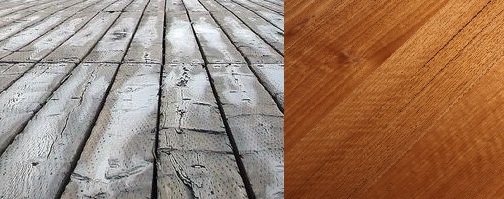
(left) Rough plank boardwalk, Quebec Metropolis, Canada (right) Finished mount ash flooring. (CC BY-SA 4.0; WikiPedant and CC BY-SA 2.5; MarkAnthonyBoyle, respectively).
As y'all can see, the texture of the finished woods is much smoother than the initial grainy wood.
Color
The changing of color of a substance is not necessarily an indicator of a chemical change. For example, changing the colour of a metal does not change its concrete properties. However, in a chemical reaction, a colour modify is usually an indicator that a reaction is occurring. Painting the metal car does non changing the limerick of the metal substance.
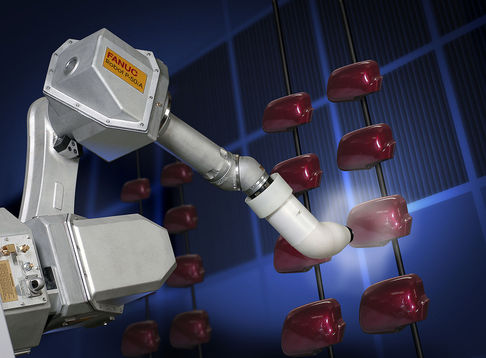
Robotic arm applying pigment on car parts. Image use with permission (CC Past-SA four.0l RoboGuru).
Temperature
Although nosotros cannot meet temperature change, unless if a change of state is occurring, information technology is a concrete change.
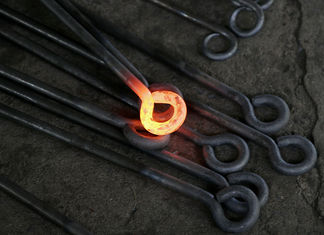
Hot metalwork. (CC Past-SA-NC two.0; flagstaffotos.com.au)
Ane cannot see the pan physically irresolute shape, colour, texture, or whatsoever of the other physical properties. However, if ane were to touch the pan, it would be incredibly hot and could crusade a burn. Sitting idle in a cupboard, this pan would exist cold. One cannot assess this change only through visual exposure; the apply of a thermometer or other musical instrument is necessary.
Shape
The shape of an object can be inverse and the object will still remain truthful to its chemical composition. For example, if one were to fold money, as shown by the figure below, the money is still chemically the same.
Origami Money

Modify of State
The change of state is likewise a concrete alter. In this scenario, one can observe a number of concrete backdrop changing, such as viscosity and shape. As ice turns into water, it does not retain a solid shape and at present becomes a viscous fluid. The concrete "reaction" for the alter of ice into liquid water is:
\[H_2O_{(southward)} \rightarrow H_2O_{(l)}\]
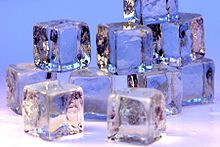
The following are the changes of land:
| Solid → Liquid | Melting |
| Liquid → Gas | Vaporization |
| Liquid → Solid | Freezing |
| Gas → Liquid | Condensation |
| Solid → Gas | Sublimation |
- If rut is added to a substance, such as in melting, vaporization, and sublimation, the process is endothermic. In this instance, heat is increasing the speed of the molecules causing them move faster.
- If estrus is removed from a substance, such as in freezing and condensation, then process is exothermic. In this example, oestrus is decreasing the speed of the molecules causing them move slower.
Physical Backdrop
Luster
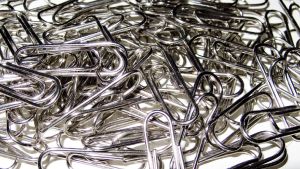
The luster of an chemical element is defined as the mode it reacts to light. Luster is a quality of a metal. Nigh all of the metals, transition metals, and metalloids are lustrous. The not-metals and gases are not lustrous. For example, oxygen and bromine are not lustrous. Shown below is are lustrous paper clips.
Lustrous Paperclips
Malleability
Malleability is also a quality of metals. Metals are said to be malleable. This means that the metals can deform under an amount of stress. For example, if you can striking a metal with a mallet and it deforms, it is malleable. Also, a paperclip can exist shaped with bare hands.
Aptitude Paperclip
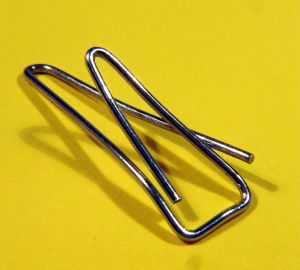
The image shows the malleability of a certain metal every bit stress is applied to it.
Ability to be drawn into a thin wire
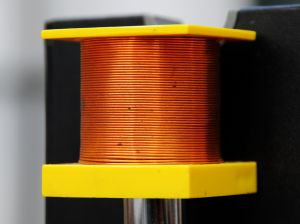
In materials science, this property is called ductility. For instance, raw copper can exist obtained and it tin be purified and wrapped into a cord. Once once more, this property is characteristic of mainly metals, nonmetals do non possess this quality.
Copper Wire
Density
The density of an object is its mass divided by its volume (d=m/v). A substance will have a higher density if it has more mass in a fixed amount of volume. For example, accept a ball of metallic, roughly the size of a baseball, compressed from raw metal. Compare this to a baseball made of paper. The baseball fabricated of metal has a much greater weight to it in the aforementioned amount of volume. Therefore the baseball made out of metallic has a much higher density. The density of an object will also decide whether it volition sink or float in a particular chemical. Water for example has a density of 1g/cmiii. Any substance with a density lower than that will bladder, while any substance with a density above that volition sink.
Oil Sinking in a Glass of H2o

Viscosity
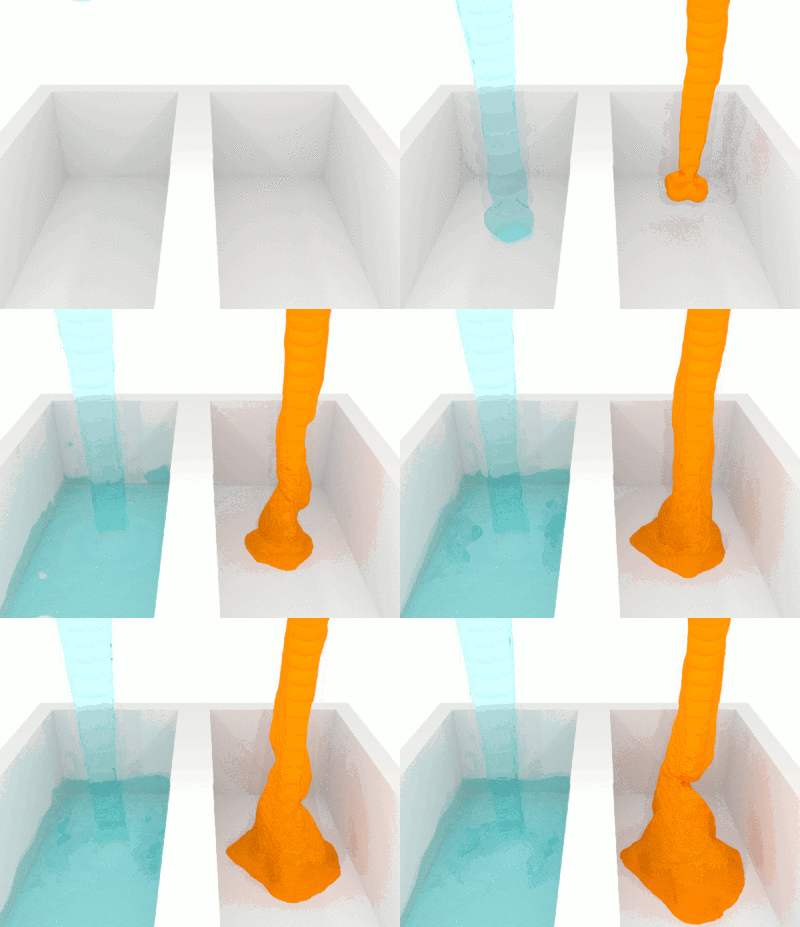
Viscosity is defined to exist the resistance to deformation of a particular chemic substance when a forcefulness is applied to it. In the instance below, one can see ii cubes falling into two dissimilar test tubes. The upper substance shows a violent reaction to the dropping of the cube. The lower substance but engulfs it slowly without much reaction. The upper substance has a lower viscosity relative to the lower substance, which has very high viscosity. Ane may even recall of viscosity in terms of thickness. The substance with more than thickness has college viscosity than a substance that is accounted "thin." Water has a lower viscosity than honey or magma, which take relatively high viscosities.
Viscosity of Fluids
Common Chemical Changes
The follow are all indicators of chemical reactions. For farther information on chemical reactions, please refer to Chemical Reactions.
Change in Temperature
A change in temperature is characteristic of a chemical change. During an experiment, one could dip a thermometer into a chalice or Erlenmeyer Flask to verify a temperature modify. If temperature increases, as it does in near reactions, a chemical change is likely to be occurring. This is unlike from the concrete temperature change. During a concrete temperature modify, one substance, such every bit h2o is being heated. However, in this example, 1 compound is mixed in with some other, and these reactants produce a product. When the reactants are mixed, the temperature modify acquired by the reaction is an indicator of a chemical change.

As an example of a exothermic reaction, if \(Fe_2O_3\) is mixed with Al and ignighted (often with called-for Mg), then the thermite reaciton is initiated
\[Fe_2O_3 + 2Al \rightarrow 2Fe + Al_2O_3 + \text{Rut}\]
This reaction generates heat as a production and is (very) exothermic.
Notwithstanding, physical changes can exist exothermic or endothermic. The melting of an ice cube, which is endothermic, is a change in a physical property and non limerick. Thus, it is a physical change.
Change in Color
A change in color is also another characteristic of a chemical reaction taking identify. For example, if one were to observe the rusting of metal over fourth dimension, one would realized that the metal has changed color and turned orange. This change in color is evidence of a chemical reaction. However, one must exist careful; sometimes a modify in color is simply the mixing of ii colors, but no real change in the composition of the substances in question.
Metal Rusting
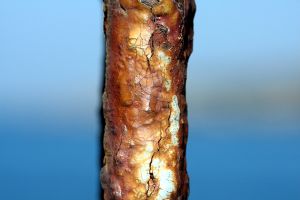
The reaction above is that of the rusting of iron.
\[4Fe + 3O_2 + 6H_2O \rightarrow 4Fe(OH)_3\]
Noticeable Scent
When two or more than compounds or elements are mixed and a scent or odor is present, a chemical reaction has taken identify. For example, when an egg begins to smell, (a rotten egg) a chemical reaction has taken place. This is the consequence of a chemical decomposition.
Spoiled Egg
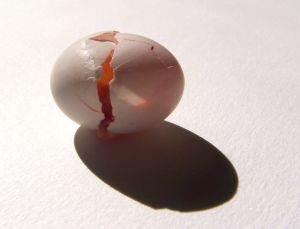
Formation of a Precipitate
The germination of a precipitate may be one of the near mutual signs of a chemical reaction taking identify. A precipitate is divers to be a solid that forms within of a solution or some other solid. Precipitates should non be confused with suspensions, which are solutions that are homogeneous fluids with particles floating about in them. For instance, when a soluble carbonate reacts with Barium, a Barium Carbonate precipitate tin be observed.
Test Tube
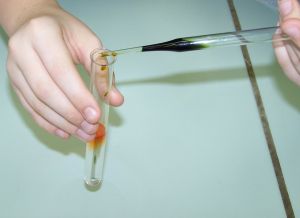
Reaction:
\[Ba^{two+}_{(aq)} + CO^{2-}_{3\;(aq)} \rightarrow BaCO){iii\;(s)}\]
For further information, delight refer to Classification of Matter.
Formation of Bubbles
The germination of bubbles, or rather a gas, is another indicator of a chemical reaction taking place. When bubbles grade, a temperature modify could also be taking identify. Temperature change and formation of bubbles often occur together. For example, in the following paradigm, one can come across a gas spewing. This is the formation of a gas.
Gas Formation
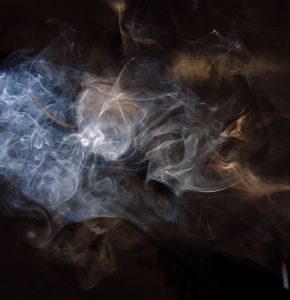
However, near reactions are much more than subtle. For instance, if the post-obit reaction occurs, i may detect Carbon Dioxide bubbles forming. If in that location is enough Hydrochloric acid, bubbles are visible. If at that place isn't, ane can't readily notice the change:
\[Na_2CO_3 + 2HCl \rightarrow 2NaCl + H_2O + CO_2\]
References
- Chang, Raymond. General Chemistry: the Essential Concepts. Boston, MA: McGraw-Hill Higher Instruction, 2006. Print.
- Chemistry for Dummies. For Dummies, 2008. Print.
- Petrucci, Ralph H. General Chemistry Principles and Modern Applications. Upper Saddle River, NJ: Pearson/Prentice Hall, 2007. Print.
Outside Links
All images are courtesy of http://www.sxc.hu, which provides royalty complimentary images that are free to exist copied without restrictions. The viscosity paradigm is likewise free to be duplicated equally per permission of author on Wikipedia.com.
Bug
1. Which of the post-obit is a chemic reaction?
- Freezing liquid Mercury
- Adding yellow to blue to make green
- Cutting a piece of paper into 2 pieces
- Dropping a sliced orange into a vat of Sodium Hydroxide
- Filling a balloon with natural air
2. Which of the post-obit is a physical reaction?
- Shattering Glass with a baseball
- Corroding Metal
- Fireworks Exploding
- Lighting a friction match
- Baking a cake
iii. Which of the following is a chemical reaction?
- Painting a wall blue
- A cycle rusting
- Water ice cream melting
- Scratching a primal across a desk
- Making a sand castle
iv. Which of the post-obit is a physical reaction?
- Frying an egg
- Digesting carrots
- A Macbook falling out of a window
- Creating ATP in the human body
- Dropping a fizzy tablet into a drinking glass of water
5. Write C for Chemical Reaction or P for Physical Reaction.
- Burning Leaves
- Cutting Diamonds
- Crushing a pencil
- The salivary amylase enzyme that breaks down nutrient in the mouth
- Salt mixing in with h2o
Answers
i. D
2. A
iii. B
4. C
5. a) C
b) P
c) P
d) C
e) Neither. This is one of the grayness areas of chemical change and concrete modify. Although the salt has dissociated into Sodium and Chloride ions, it is notwithstanding salt in water. Salt, initially is actually merely a conglomerate of sodium and chloride ions and past dissociating them, merely the organisation of the ions has changed. Delight click hither for more data.
Source: https://chem.libretexts.org/Bookshelves/Physical_and_Theoretical_Chemistry_Textbook_Maps/Supplemental_Modules_%28Physical_and_Theoretical_Chemistry%29/Fundamentals/Chemical_Change_vs._Physical_Change
0 Response to "In Order to Decide Whether a Property Is Chemical or Physical"
Post a Comment